
How Does A Power Inverter Work In A Car: Easy Guide
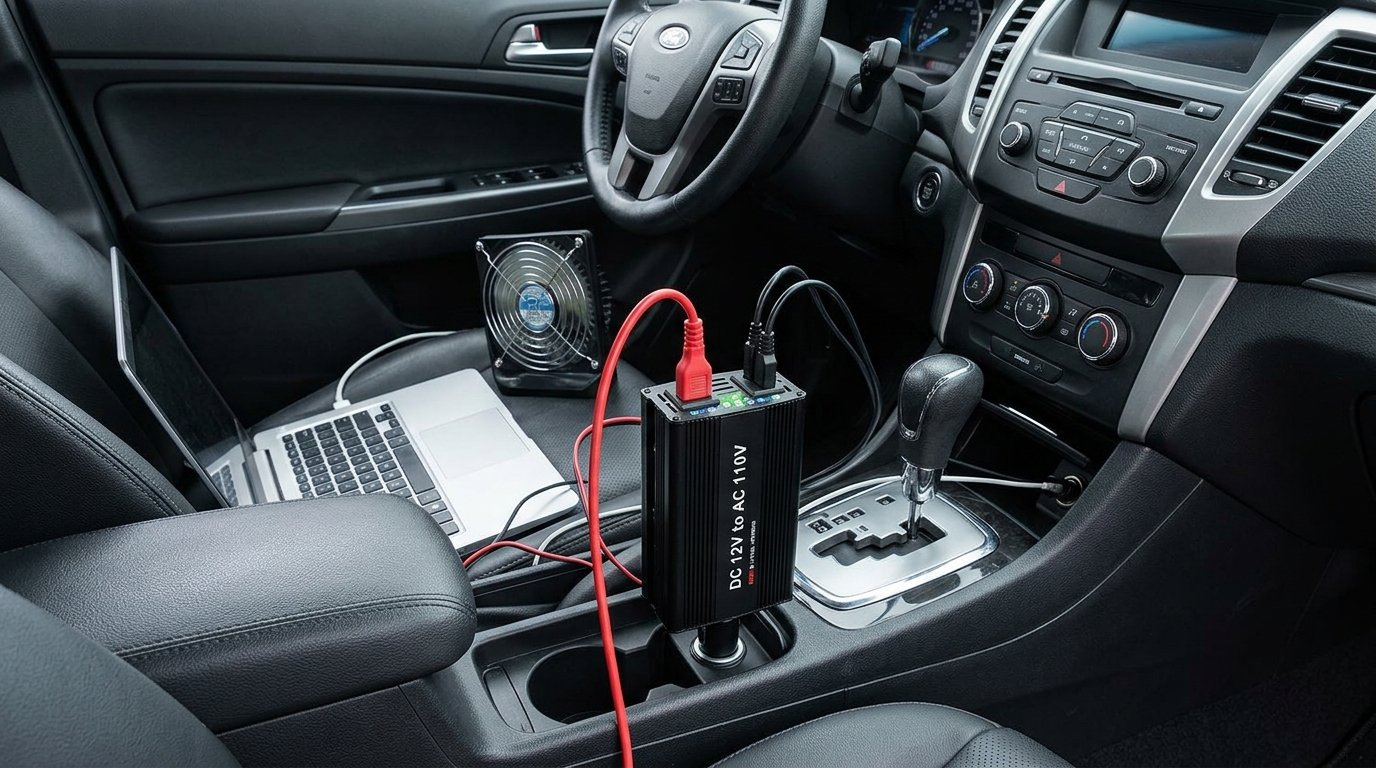
A car power inverter changes 12-volt battery power into household-style AC power for small devices.
Understanding how does a power inverter work in a car helps you use laptops, chargers, small TVs, and other devices safely on the road. The process is simple in theory, but battery limits, heat, wiring, and electrical load all matter. This guide explains the technology in plain language, with practical tips that can help you choose and use the right inverter.

What Is a Car Power Inverter?
A car power inverter is an electronic device that converts direct current, or DC, from a vehicle battery into alternating current, or AC. Most household devices use AC power, while a car battery stores DC power.
This is the basic answer to how does a power inverter work in a car: it acts as a bridge between the battery and an AC-powered device. You plug the inverter into the 12-volt accessory socket or connect it directly to the battery, then plug your device into the inverter’s AC outlet.
A vehicle battery is usually called a 12-volt battery, but its voltage changes. It may show about 12.6 volts when fully charged and the engine is off. When the engine runs, the alternator often raises system voltage to roughly 13.5 to 14.7 volts.
A power inverter does not create energy. It changes the form of energy already available in the battery and charging system. Some energy is also lost as heat during the conversion.

How Does a Power Inverter Work in a Car?
To understand how does a power inverter work in a car, picture the battery as a steady stream of water flowing in one direction. Household appliances need a current that changes direction many times each second. The inverter reshapes the battery’s steady DC flow into an AC waveform.
Inside the inverter, several electronic parts work together:
- The input circuit receives DC power from the car battery.
- Switching transistors turn the DC current on and off very quickly.
- A control circuit creates a changing electrical pattern.
- A transformer or electronic voltage stage raises the voltage.
- The output circuit sends AC power to the device.
In the United States, household outlets supply about 120 volts AC at 60 hertz. Many car inverters produce a similar output, although the exact voltage and waveform depend on the model.
The inverter also monitors temperature, input voltage, and output load. If it detects too much heat, a weak battery, or excessive current, it may shut down. This protection helps prevent damage to the inverter, vehicle wiring, and connected equipment.
The conversion is not perfectly efficient. A good inverter may operate around 85% to 95% efficiency under suitable conditions. The rest of the energy becomes heat, so ventilation is important.

Main Parts Inside a Car Power Inverter
Knowing the main parts makes how does a power inverter work in a car easier to understand. Each part has a specific job, much like parts in a small electrical power station.
DC input terminals
These connect the inverter to the vehicle’s 12-volt electrical system. Small models often use a cigarette lighter plug. Larger models usually use cables connected directly to the battery.
Electronic switches
Power transistors switch the DC current rapidly. Their timing controls the shape and frequency of the AC output.
Transformer or voltage converter
The vehicle battery provides low voltage. The inverter raises this voltage to a level that household devices can use. Modern models may use high-frequency electronic circuits instead of a large traditional transformer.
Cooling system
Many inverters use vents, heat sinks, or fans. Heat increases when the inverter supplies more power, especially near its maximum rating.
Safety circuits
Common protection features include:
• Low-voltage shutdown
• Overload protection
• Short-circuit protection
• Over-temperature protection
• Input reverse-polarity protection
• Internal fuses
A safety feature is helpful, but it does not make careless wiring safe. Correct cable size, fusing, and placement still matter.
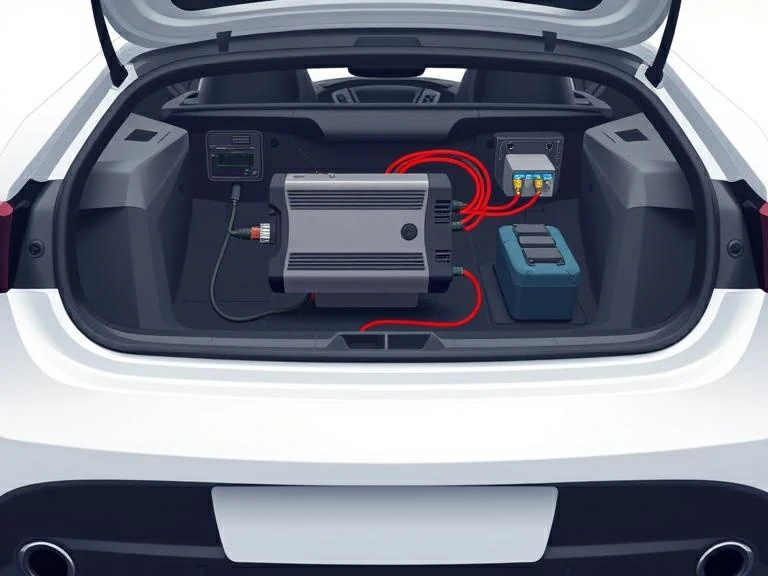
DC Power to AC Power: A Simple Example
Suppose you plug a 60-watt laptop charger into a car inverter. The charger needs AC power, but the car supplies DC power. The inverter changes the battery’s DC energy into AC energy that the charger can accept.
The inverter must draw more than 60 watts from the battery because conversion wastes some energy. At 90% efficiency, the required input power is about 67 watts.
You can estimate battery current with this formula:
Battery current = Appliance watts ÷ Battery voltage ÷ Inverter efficiency
For a 60-watt device:
60 ÷ 12 ÷ 0.90 = about 5.6 amps
That is a useful estimate. Actual current can vary with battery voltage, cable loss, startup demand, and inverter design.
A 1,000-watt appliance can require close to 93 amps from a 12-volt system at 90% efficiency. That level is far beyond what most dashboard outlets can safely provide. It usually requires short, heavy cables, a fuse near the battery, and professional installation.
What Can You Power With a Car Inverter?
How does a power inverter work in a car in daily use? It supplies AC power to devices that stay within the inverter’s continuous and surge ratings.
Small inverters may handle devices such as:
• Smartphones and tablets
• Camera batteries
• Laptop chargers
• Small LED lights
• Portable game systems
• Low-power medical or travel equipment, when approved for that use
Larger inverters may run:
• Small televisions
• Compact fans
• Some small kitchen devices
• Certain power tools
• Portable monitors
Some devices are difficult to run from a car inverter. Motors, compressors, pumps, laser printers, refrigerators, and heating devices can demand a large startup surge.
For example, a small refrigerator may use modest power after starting but require much more power for a short moment when its compressor begins. An inverter with only a small surge rating may shut down even when its continuous wattage looks sufficient.
Always check both ratings:
• Continuous power is the load the inverter can supply over time.
• Surge power is the short burst available during startup.
How to Calculate the Right Inverter Size
Choosing the correct size is a key part of understanding how does a power inverter work in a car. Start by checking the wattage label on every device you plan to use.
Add the running wattage of the devices. Then allow extra capacity for startup surges and small measurement errors. A practical target is often 20% to 30% more continuous capacity than your expected load.
For example:
• Laptop charger: 65 watts
• Phone charger: 20 watts
• Small light: 10 watts
• Total: 95 watts
A 150-watt or 200-watt inverter would usually provide a sensible margin for this group of devices.
Avoid choosing an inverter based only on the biggest number printed on the box. A model labeled “1,000 watts” may support that output only for a few seconds. Its continuous rating may be much lower.
Also check the vehicle outlet rating. Many accessory sockets are protected by a 10-amp or 15-amp fuse. At 12 volts, that suggests a rough limit of 120 to 180 watts before considering safety margins and wiring losses. Your vehicle manual should take priority.

Pure Sine Wave vs. Modified Sine Wave Inverters
The output waveform affects how some devices perform. This is an important part of how does a power inverter work in a car because not all AC output is shaped the same way.
Modified sine wave
Modified sine wave inverters create a stepped waveform. They are often less expensive and may work well with simple chargers, lights, and basic electronics.
However, some devices may:
• Produce a buzzing sound
• Run hotter
• Show interference
• Work less efficiently
• Fail to start
Pure sine wave
Pure sine wave inverters create a smoother waveform that more closely matches utility power. They are a better choice for sensitive electronics, audio equipment, medical devices, induction motors, and appliances with precise electronic controls.
Pure sine wave models usually cost more, but the extra cost can be worthwhile when device compatibility matters. If the equipment maker requires a pure sine wave supply, follow that requirement.
A phone or laptop charger may work with either type, but “may work” is not the same as “ideal.” If a device is expensive, sensitive, or essential, pure sine wave output is the safer choice.

Can a Car Inverter Drain the Battery?
Yes. An inverter can drain a car battery, especially when the engine is off. How does a power inverter work in a car when the engine is running? The alternator helps supply power and recharge the battery, but it still has limits.
A 60-watt load may be manageable for a short time with a healthy battery. A 500-watt load can drain the battery quickly when the engine is not running.
A standard starting battery is designed to deliver a strong burst for engine starting. It is not designed for repeated deep discharge. Frequent deep discharge can shorten its service life.
Use these habits:
• Run higher loads only with the engine running.
• Turn the inverter off when you leave the vehicle.
• Watch for low-voltage warnings.
• Do not rely on the inverter to keep a weak battery alive.
• Use a separate deep-cycle battery for long off-grid use.
Never run the engine in a closed garage or enclosed space. Carbon monoxide can build up without warning and may be fatal.
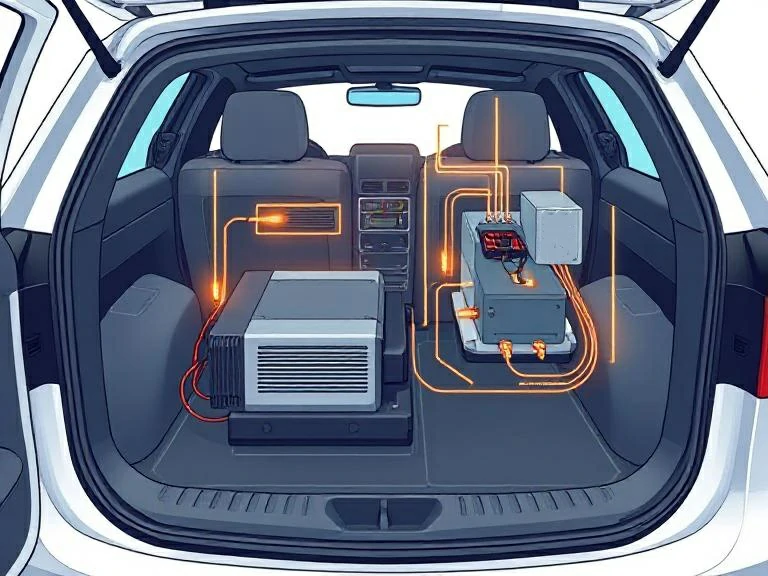
Is It Safe to Use an Inverter While Driving?
Using a properly rated inverter while driving is usually safe, but placement and wiring matter. It should sit on a firm surface with open airflow. Do not cover it with clothing, bags, or floor mats.
Keep cords away from the pedals, steering controls, seat rails, and hot surfaces. A loose cable can become a trip hazard or interfere with vehicle control.
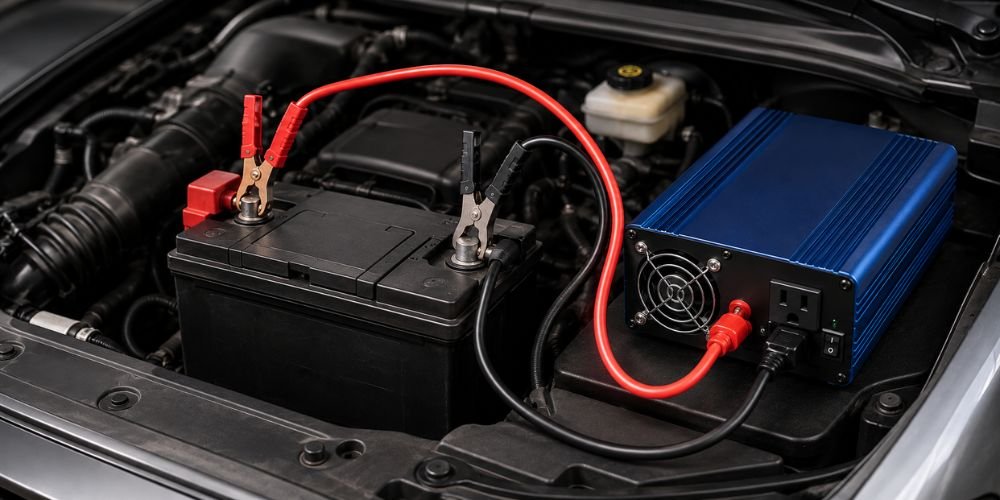
For larger models, direct battery connection is often better than a dashboard socket. The installation should include:
• A fuse close to the positive battery terminal
• Correctly sized cables
• Secure terminals
• Protection from sharp metal edges
• Good airflow around the inverter
• A solid ground connection
A common hands-on mistake is treating a high-wattage inverter like a phone charger. A 1,500-watt inverter can draw more than 100 amps from a 12-volt system. That requires serious wiring, not a thin accessory cord.
Common Problems With Car Power Inverters
Understanding how does a power inverter work in a car also helps you diagnose faults. Many problems come from overload, poor connections, or low battery voltage.
The inverter shuts off
This may happen because of:
• Too much connected wattage
• A motor startup surge
• Low battery voltage
• Excessive heat
• A blown fuse
• Loose cables
Disconnect the devices and test the inverter with a small load. If it works normally, reconnect devices one at a time.
The inverter beeps
A beep may indicate low voltage or overload. Check the manual because warning sounds differ by manufacturer.
The device does not work
The output may not match the device’s needs. The device may also need pure sine wave power, or its startup surge may exceed the inverter’s rating.
The plug or socket gets hot
Heat at the plug can signal excessive current, a loose connection, or a damaged socket. Stop using the inverter until the cause is found. A warm electrical plug should not be ignored.
The inverter smells hot
Turn it off at once and unplug the load. A burning smell may point to damaged insulation, an internal failure, or an overloaded circuit.
How to Choose the Best Car Power Inverter
The best inverter depends on your vehicle, devices, and expected use. Before buying, check these features:
• Continuous wattage rating
• Surge wattage rating
• Pure or modified sine wave output
• Number and type of AC outlets
• USB-A or USB-C charging ports
• Input cable length and thickness
• Built-in fuse and protection features
• Cooling fan noise
• Warranty and safety certification
For occasional phone and laptop charging, a small 100-watt to 300-watt model may be enough. For larger equipment, calculate the real load and consider direct battery wiring.
Choose a model with a recognized safety certification for the market where you live. Certification does not guarantee perfect performance, but it offers more confidence than an unmarked product with extreme claims.
Avoid buying based only on price. A poorly built inverter can produce electrical noise, run hot, or lack reliable protection. In electrical equipment, quality is often cheaper than repairing damaged devices or wiring.
Car Inverter Safety Tips
Safe use comes down to managing current, heat, and battery energy. These practical rules cover most common risks:
- Read the vehicle and inverter manuals before installation.
- Match the inverter’s continuous rating to your real load.
- Allow extra capacity for startup surges.
- Never exceed the vehicle outlet’s fuse rating.
- Use a fuse near the battery for direct connections.
- Keep the inverter dry and well ventilated.
- Do not place it near fuel, water, or loose metal objects.
- Inspect plugs and cables for damage.
- Disconnect the inverter when it is not needed.
- Do not use it as a substitute for a properly installed home electrical system.
People sometimes ask how does a power inverter work in a car after seeing an inverter rated at several thousand watts. The number may be real, but the vehicle must also support the required current. The battery, alternator, cables, fuse, and connection points all need to handle the load.
Frequently Asked Questions About How Does a Power Inverter Work in a Car
Does a car inverter change 12 volts DC into 120 volts AC?
Yes. A car inverter converts the vehicle’s low-voltage DC power into higher-voltage AC power. The exact output voltage and waveform depend on the inverter model.
Can I plug a power inverter into a cigarette lighter socket?
You can use a small inverter if its power draw stays within the socket’s fuse and wiring limits. Larger inverters should normally connect directly to the battery with the correct fuse and cable size.
Will a car inverter work when the engine is off?
Yes, but it draws energy from the battery and can prevent the vehicle from starting. Use only small loads for short periods unless you have a suitable auxiliary battery.
Can a car inverter run a refrigerator?
Some can, but the inverter must handle the refrigerator’s startup surge and continuous demand. A pure sine wave model is often the better choice for compressor-based appliances.
Is a pure sine wave inverter better for a laptop?
A laptop charger may work with a modified sine wave inverter, but pure sine wave output provides cleaner power. It is a sensible choice for sensitive or expensive electronics.
Why does my car inverter keep shutting down?
The usual causes are overload, low battery voltage, overheating, poor connections, or a blown fuse. Reduce the load, improve airflow, and check the cables and manual before using it again.
Does an inverter charge the car battery?
No. A standard inverter changes DC into AC, but it does not charge the battery. A separate battery charger or vehicle charging system is needed to restore battery power.
Conclusion
A car power inverter converts battery DC into household-style AC through rapid electronic switching, voltage conversion, and waveform control. Its safe performance depends on the inverter rating, device demand, battery condition, wiring, ventilation, and vehicle outlet limits.
Small models are useful for chargers, laptops, and other light loads. Larger devices need careful calculations and direct battery wiring. Use the engine and alternator wisely, protect the circuit with the right fuse, and never ignore heat or warning signs.
Now that you know how does a power inverter work in a car, check your device wattage and vehicle fuse rating before buying one. Choose a quality model that fits your real needs, and explore more vehicle power guides or share your questions in the comments.